12285 Scripps Poway Parkway Suite 104 Poway, CA 92064

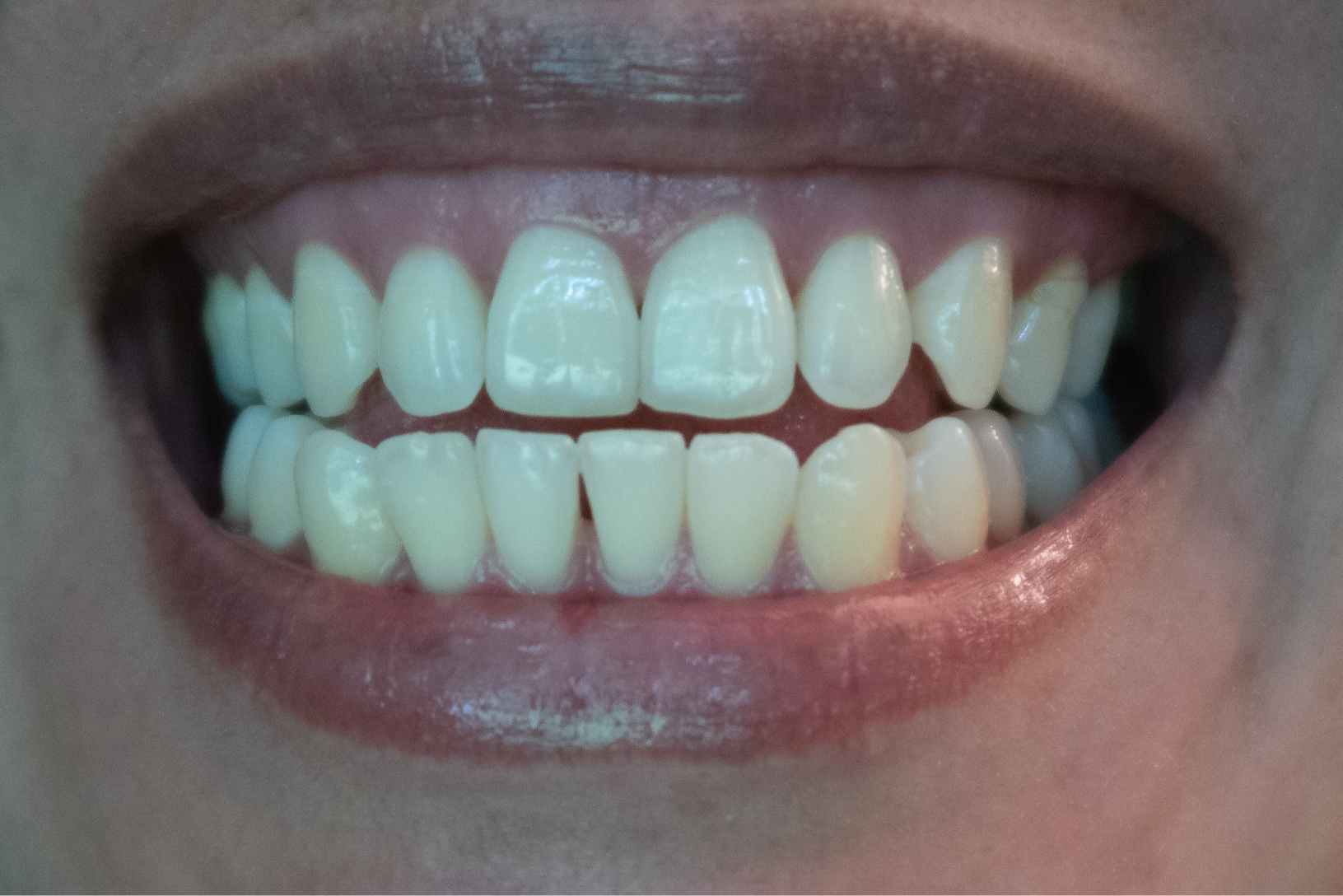
Most people describe them as gaps.
They’re not. A black triangle isn’t extra space between your teeth. It’s missing gum between your teeth, and that distinction decides everything about whether it can be fixed.
Patients rank black triangles as the third most disliked cosmetic dental problem, behind only visible decay and dark crown margins. Research also found that both dentists and patients rate any triangle larger than 3mm as noticeably less attractive. So if you’ve been staring at yours in the bathroom mirror, you’re not being vain. You’re seeing something people genuinely notice.
Here’s what almost nobody explains at a cosmetic consultation.
The Measurement That Decides Everything
In 1992, a periodontist named Dennis Tarnow published a study measuring the vertical distance from the contact point between two teeth down to the crest of the bone underneath.
The findings were remarkably clean:
- 5mm or less: the gum fills the space about 98% of the time
- 6mm: it fills about 56% of the time
- 7mm or more: the papilla is missing in roughly three out of four cases
That’s it. That’s the rule. Whether gum tissue can occupy that triangle is governed by how far it has to climb from the bone.
Which means the honest answer to “can this be fixed” depends on a number under your gums, not on how motivated you are or which product you buy.
The Uncomfortable Data About Clear Aligners
We offer Invisalign, so this is awkward to publish. It’s also true, and you should know it before you start.
A retrospective study of 200 adults compared black triangle formation after clear aligners versus traditional braces. Open gingival embrasures appeared between the upper front teeth in 35% of the clear aligner group versus 18% of the fixed appliance group, and between the lower front teeth in 38% versus 24%. The triangles were also larger on average with aligners.
More broadly, systematic reviews put black triangle incidence after orthodontic treatment somewhere between 38% and 58% in adults, compared with about 15% in adolescents.
None of this means don’t do Invisalign. It means the risk should be part of the conversation before you sign, especially if you’re over 40, have any gum recession, or have triangular-shaped front teeth. All three raise your odds.
What Each Option Actually Does
Bonding. Composite is added to the sides of the teeth to move the contact point downward, closer to the bone. This is often the most practical fix, it’s done in one visit, and it’s reversible in a way veneers are not. The trade-off is that composite stains over years and needs occasional polishing or replacement.
Veneers. Porcelain can reshape teeth to close triangles beautifully, particularly when you also want to change color or shape. But veneers require removing enamel, so it’s a permanent commitment for what may be a small aesthetic problem. If black triangles are your only complaint, this is often more treatment than the situation warrants.
Invisalign with IPR. On its own, moving teeth closer together usually doesn’t fix a black triangle, because the papilla gap is set by bone height. The actual orthodontic solution pairs tooth movement with interproximal reduction, gently reshaping the sides of the teeth so the contact point sits lower and the triangle shrinks from the top down.
Treating the gums. If active gum disease causes bone loss, that comes first. Always.
Surgical papilla reconstruction. It exists. It’s also genuinely unpredictable, because the interdental papilla is tiny and its blood supply is limited. Anyone promising you a guaranteed surgical rebuild is overselling.
Why We Look at Your Gums Before Your Teeth
Filling a black triangle without asking why it appeared is how a cosmetic problem becomes a dental one.
If bone loss from periodontal disease created the space, bonding over it seals plaque against an already inflamed site. Black triangles also trap food and raise the risk of decay on the root surface, which is softer than enamel and less forgiving.
The other common cause is entirely mechanical: aggressive brushing and traumatic flossing. If that’s what’s driving it, technique has to change or the same thing happens again next to the new bonding.
So the first appointment is measuring and diagnosing, not sanding and shaping.
Getting a Straight Answer in Poway
We handle bonding, veneers, Invisalign, cosmetic dentistry, and gum disease treatment in the same practice, which matters more here than it does for most procedures. Black triangles sit exactly on the border between cosmetic and periodontal, and offices that only do one side of that line tend to recommend the side they do.
We see this often across Poway, Rancho Bernardo, Rancho Peñasquitos, Scripps Ranch, 4S Ranch, Sabre Springs, and Carmel Mountain Ranch, frequently in adults who just finished orthodontic treatment and noticed something new.
Schedule a consultation at our Scripps Poway Parkway office, or meet our dentists first.
Frequently Asked Questions (FAQ’s)
What causes black triangles between teeth?
Black triangles form when the gum papilla no longer fills the space between teeth, usually from bone loss, gum recession, aggressive brushing, triangular tooth shape, or orthodontic treatment.
Can black triangles be fixed permanently?
Often yes, most predictably with bonding or veneers that lower the contact point, though results depend on the distance from that contact point to the underlying bone.
Does Invisalign fix or cause black triangles?
Invisalign can cause them, appearing in roughly 35% to 38% of adult cases in one study, though combining aligners with interproximal reduction can reduce existing triangles.
Is bonding or veneers better for black triangles?
Bonding is usually the better first choice because it’s less invasive, reversible, and completed in one visit, while veneers require permanently removing enamel.
Do black triangles cause dental problems or just cosmetic ones?
Both, since they trap food, accumulate plaque, and increase the risk of root decay in addition to affecting appearance.